
The "Bending Strings" Illusion
29 July 2026
A few years ago, while preparing a lecture on binocular perception, I prepared a small diagram to clarify the so-called “correspondence problem”. This diagram (see Figure 1) included a set of solid lines interspersed with dashed lines. To my surprise, the lines that were supposed to be continuous and straight appeared to me distinctly wavy, with curves and counter-curves.
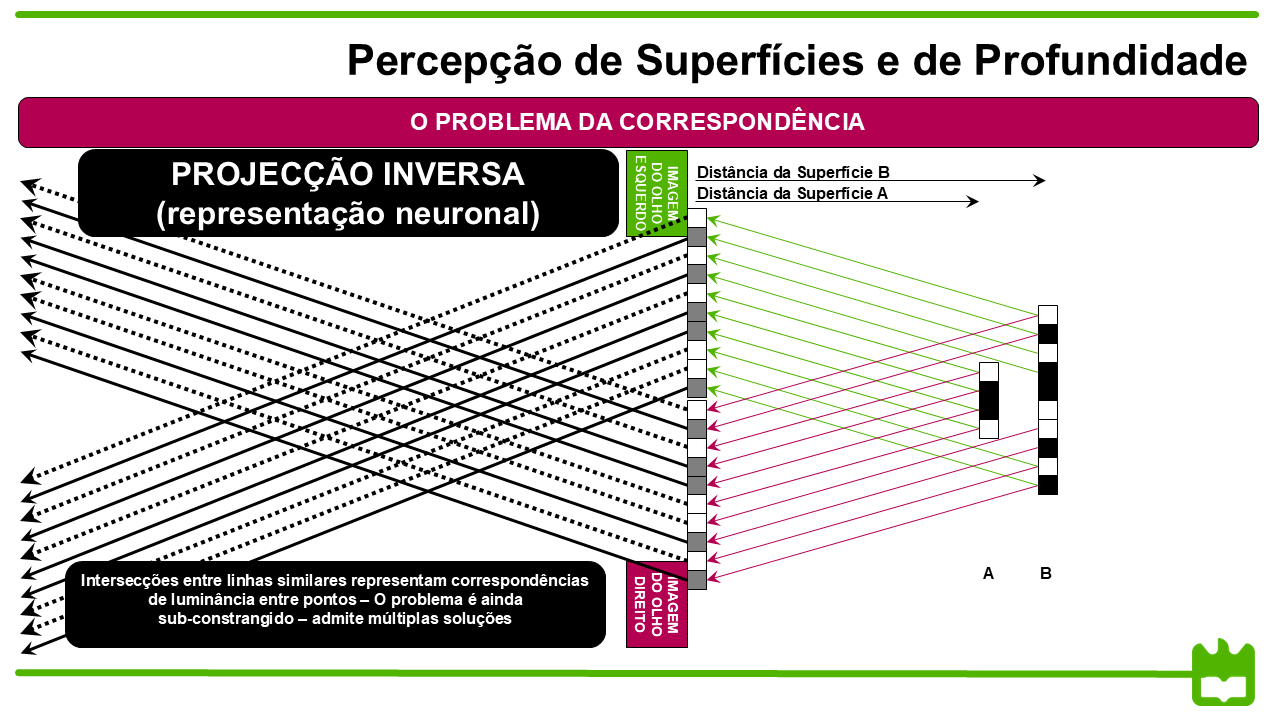
At first, I confess, I simply blamed PowerPoint – anyone who uses the program regularly knows that it is prone to the occasional glitch. However, after checking several times that the lines in question were, in fact, straight, I concluded that I was witnessing a visual illusion, which naturally deserved some attention on my part.
The effect is relatively easy to reproduce. The following video presents several variations of what I have since called “The Bending Strings Illusion”.
This is by no means one of the most striking or captivating illusions, but merely a small visual effect. I believe that, at least in part, it is due to the operation of low-level visual mechanisms – probably arising from the functioning of visual cells in the Lateral Geniculate Nucleus.
Some additional observations support this conclusion: the illusory curves appear to emerge only in peripheral and parafoveal regions, disappearing when we look directly at them, in a manner similar to what occurs with the Hermann's grid.
Along the same lines (pun not intended), convolving the image on the left-hand side of Figure 2 (a simplified version of the illusion) with a filter that simulates, albeit rather crudely, the receptive field of these cells produces the image on the right-hand side of Figure 2.
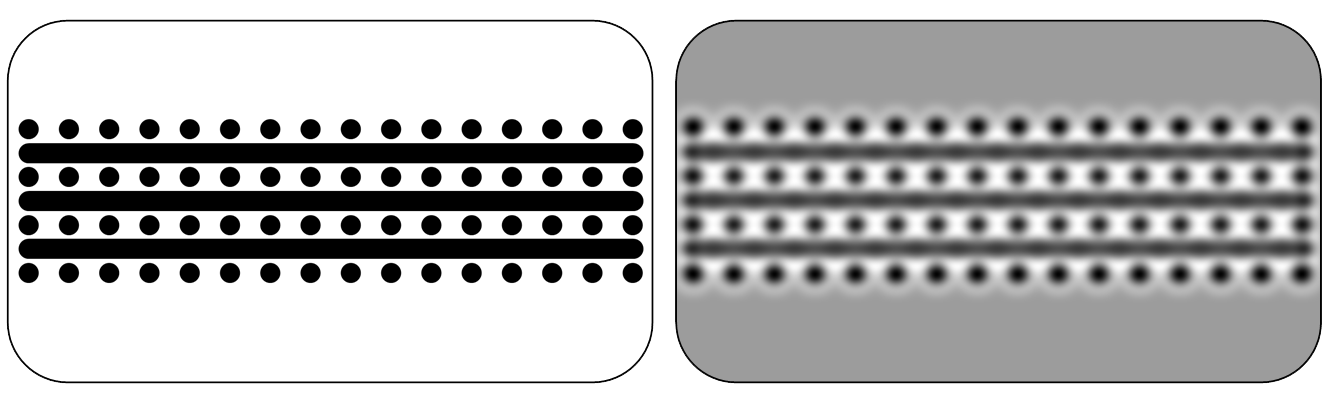
In the latter, the emergence of some undulations is evident, although it should be noted that these arise only when a receptive field of moderate size is simulated and when the lines in the original image are positioned considerably close to one another. Visually, the illusion persists when the lines are spaced somewhat further apart, suggesting that other mechanisms may also be involved.
In any case, this is certainly an illusion that warrants further empirical investigation, which I intend to undertake in the near future.