
A real life demonstration of the Checker-Shadow Illusion
The checker shadow illusion, created by Edward Adelson in 1995, is perhaps one of the most famous demonstrations of the perceptual principles underlying colour perception. In this illusion (see Figure 1, left-hand image), the two squares marked with the letters A and B are exactly the same shade of grey, even though the second appears lighter than the first (see Figure 1, right-hand image).
Figure 1
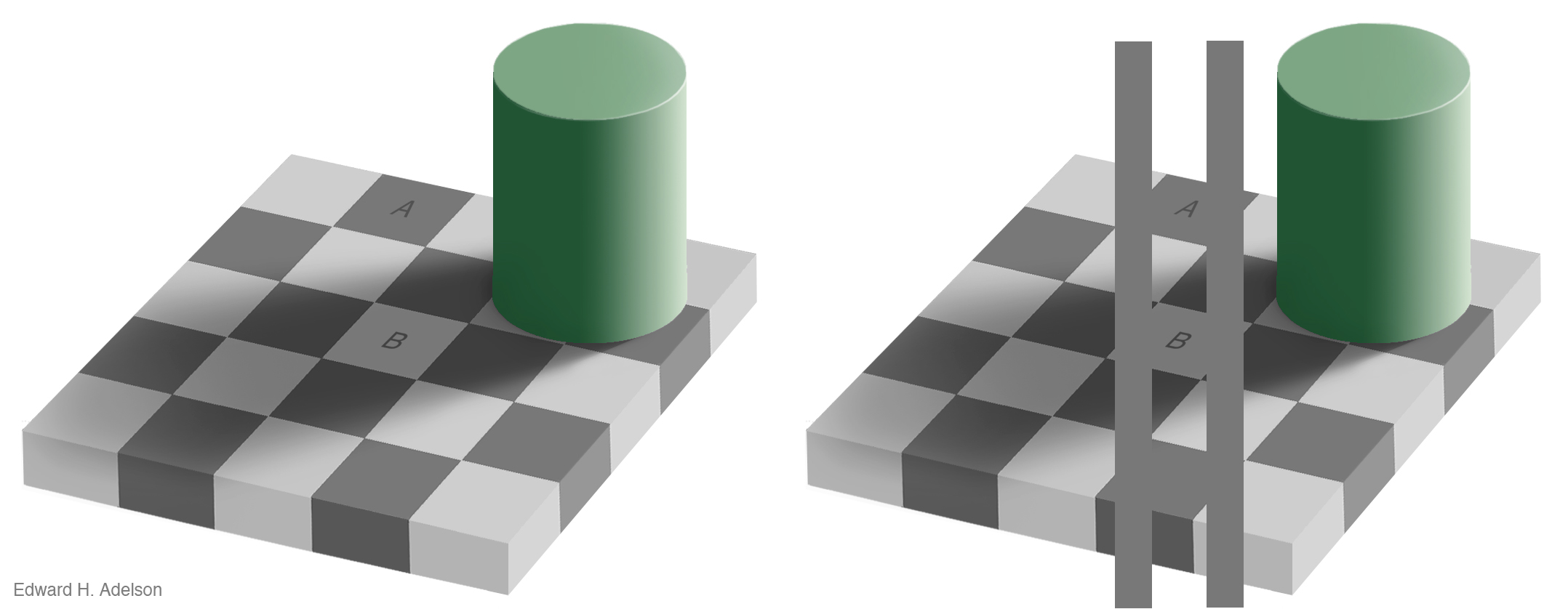
As with many other "illusions" (hence my use of inverted commas around this word), what is said to be identical — the colour of squares A and B — conceals an ambiguity that is worth clarifying, in order to properly understand the nature of the demonstration. The tone of the squares in the image (or, equivalently here, the light reaching our retina from these two regions) is, indeed, exactly the same. It so happens that our perception did not evolve solely to detect the amount of light, in absolute terms, reaching the retina — that is, indeed, the initial, basic piece of information, but it is not yet the ultimate purpose of perception. The latter aims, ultimately, to extract information about external objects, that is, in this case, the amount of light reflected by their surfaces (reflectance). Naturally, the light reaching our eyes (luminance) depends not only on the reflectance of objects (the proportion of photons reflected by their surfaces) but also on the amount of light illuminating them (illuminance). An object that reflects 50% of the light falling on it (perceived as a neutral grey) will reflect a greater or lesser amount of light depending on whether it is illuminated by a more or less intense light source. In a world where illumination varies considerably — between areas exposed to direct light and areas in shadow, or scenes lit by the midday sun, a rising or setting sun, or a more or less full moon — the perceptual ability to infer the properties of objects themselves, independently of the light reaching the retina (which can be greater or lesser, for the same object, depending on whether it is under more or less illumination), is critical for survival. Otherwise, objects would appear to us to change colour drastically were the illumination to change, or were they to move into shadow.
In the case of Adelson's illusion, for the light reaching the retina from region B to be equal to that from region A (illuminance), the surface of B must reflect more light than that of A (reflectance), since the former is in shadow and therefore subject to less illumination. This inference, made automatically by our perception, can hardly be described as illusory. The statement that "the colour of squares A and B is the same" applies, indeed, to the colours in the image (luminance), but our perception evolved to extract information about the colour of surfaces in the world (reflectance). For all that has been said, it is, in principle, impossible to recreate the checker shadow illusion with real objects and shadows — or, rather, it is impossible to recreate without resorting to tricks.
Figure 2 contains all the elements needed for a "live" version of the checker shadow illusion. It can be printed on thick paper, such as card (A3 size), with the different elements cut out. The green rectangle can be rolled up, gluing the left-hand edge to the white tab at the right-hand edge, to create a cylinder. This can then be placed over the black circle on the chessboard.
Figure 2
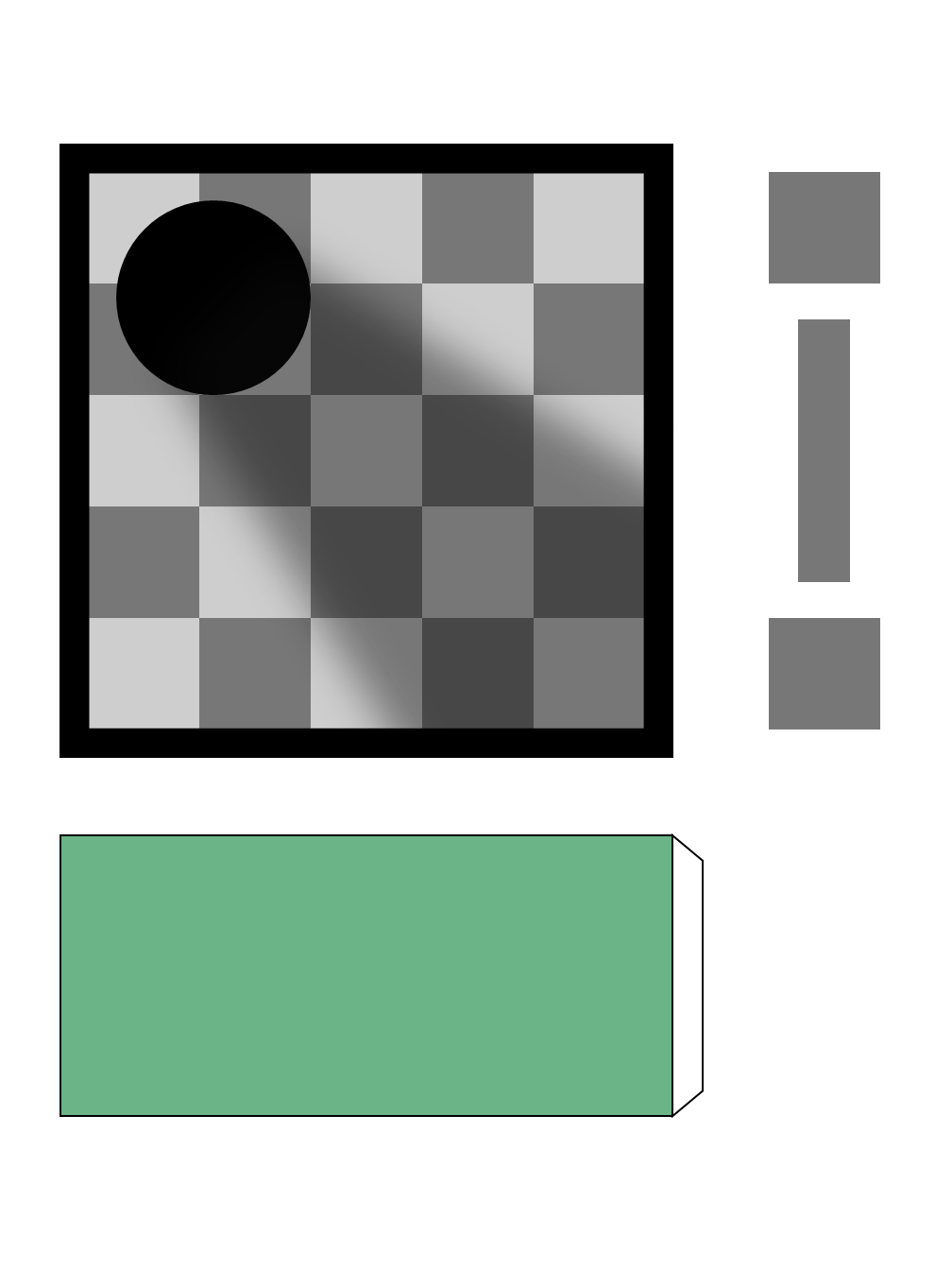
A false shadow is printed on the surface of the board — the trick that makes it possible to recreate the illusion. Finally, the squares and the rectangle on the right-hand side are the same shade of grey as the light squares inside the false shadow and the dark squares outside that same shadow. An effective way to make the demonstration convincing is to arrange the elements under a lamp, so as to cast a real shadow over the false shadow (the more closely the two align, the better), as shown in the photograph in Figure 3. With this arrangement, the loose squares can be moved freely between the areas on the board, showing that the board has the same colour as the light squares under the shadow and the dark squares outside the shadow (see Figure 4). Note that the luminance variations produced by the real shadow are, naturally, discounted by our perception, leaving only the effect caused by the false shadow (albeit disguised by the real one). Finally, the grey rectangle can be placed on the board to connect these same areas to one another, showing that their colour is identical.
Figure 3
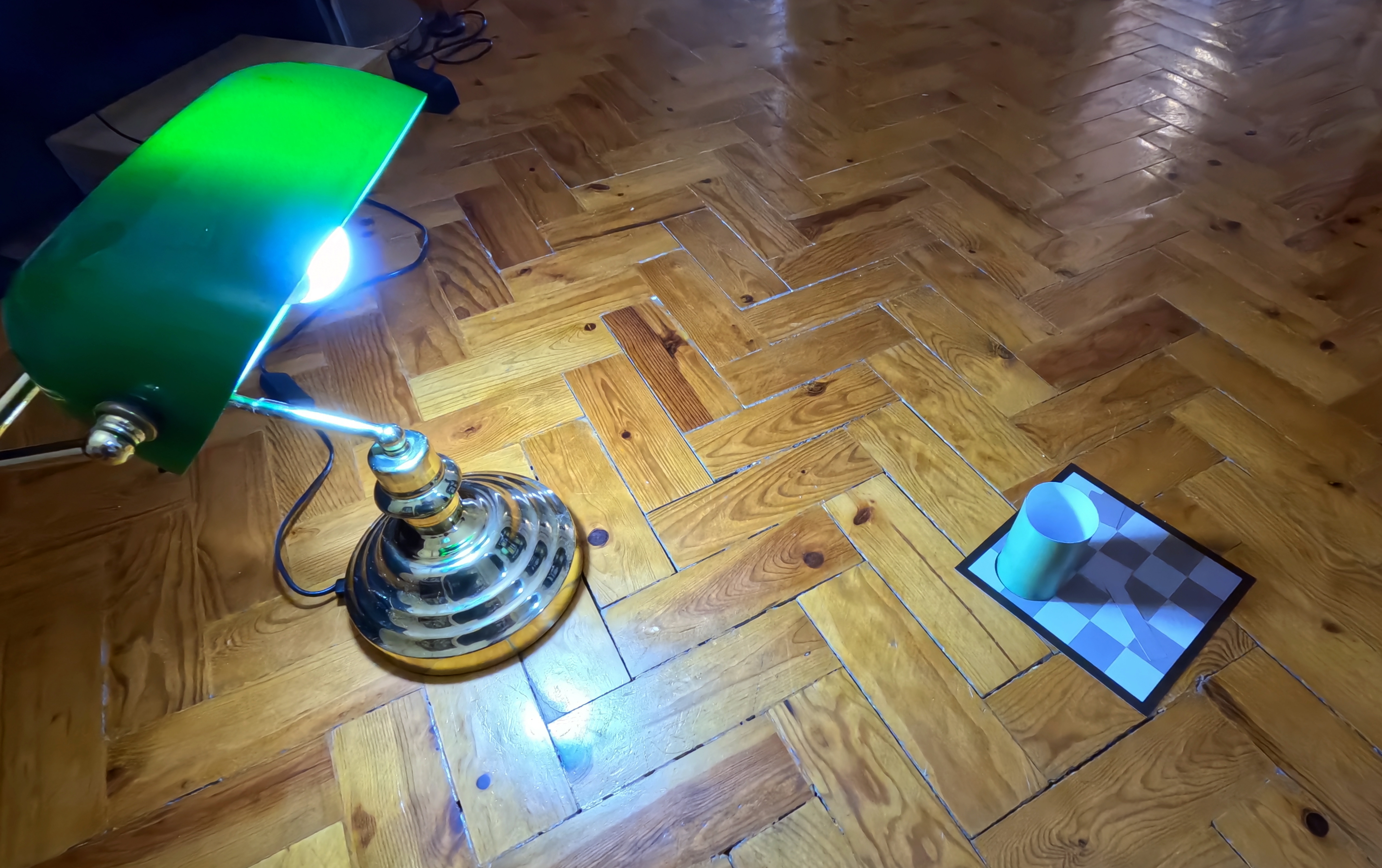
Figure 4
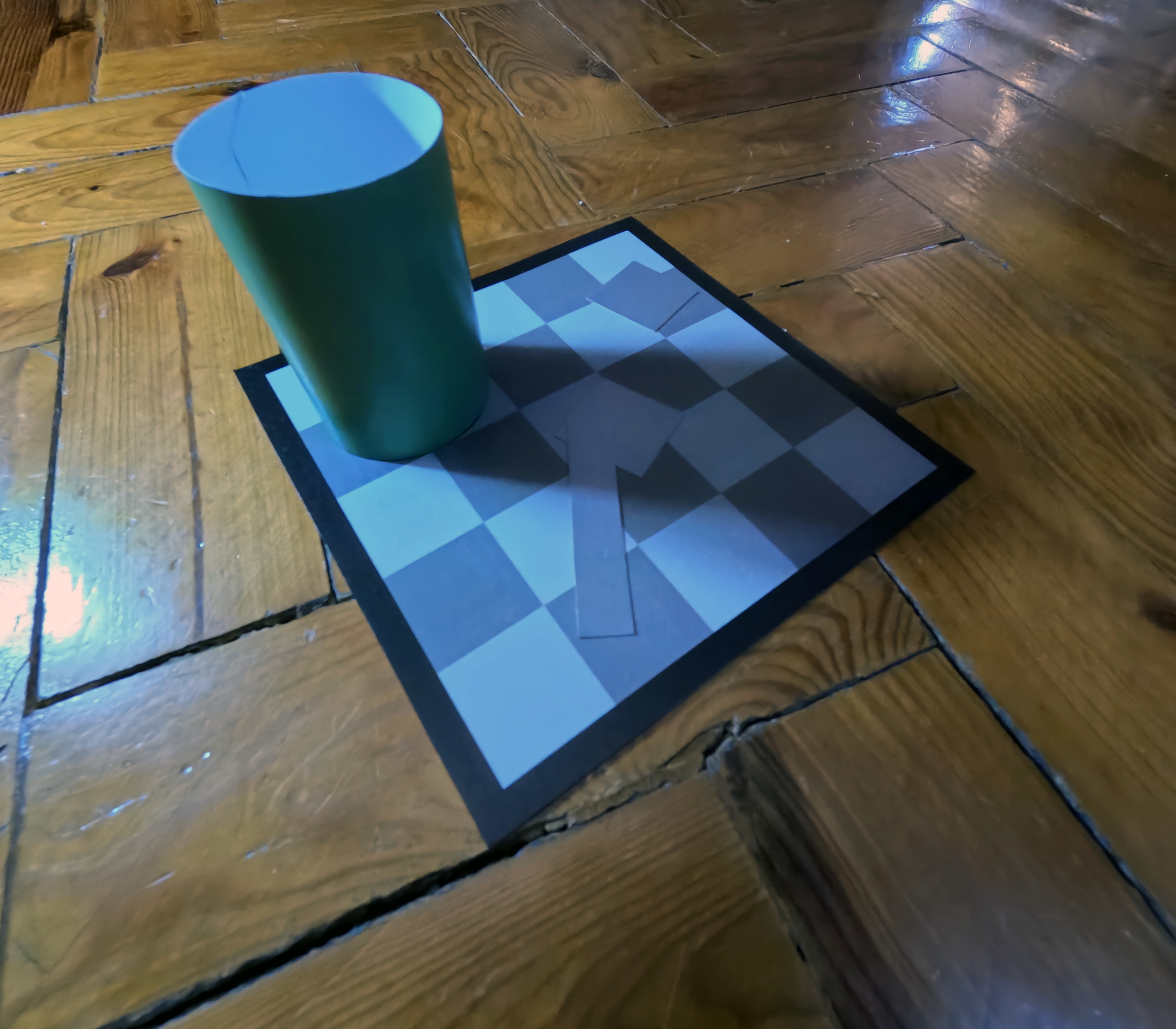
This demonstration, which can easily be carried out in a classroom, aids understanding not only of the illusion itself, but also of the nature of the perceptual processes involved. Although disguising the false shadow with a real one is essential for the illusion to work, making it obvious (by switching off the lamp, removing the cylinder, or changing the orientation of the whole set-up) is important for explaining and understanding not only the reason for the illusion, but also the perceptual inferences involved.
Bibliography
- Adelson, E. H. (1993). Perceptual organization and the judgment of brightness. Science, 262, 2042–2044.